A large rectangular seat with a beautifully carved couchant lion at one end. The modeling of the animal closely resembling the vehicle of the goddess in the mahishasuramardini cave is exceedingly well done. The lion is significantly portrayed as roaring, proclaiming as it were, the sovereign power of the Pallavas. The back is made somewhat flat to serve as a seat.
One of the finest monolithic temples at Mahabalipuram. Though three-storeyed and of better workmanship, it resembles the Bhima Ratha in roof form. The gable ends of the wagon-roof have a finial showing a human head decorated by trident-shaped headgear, the side-prongs suggesting the usual horns in the dvarapala figures and the central one wears a long and narrow crown. This Motif is repeated in the finials of decorative gables along the wagon-roof . There is a usual pavilion and kudu-ornamentation. The elaborately worked roofs has nine vase-shaped finials and is the precursor of the later gopuram, an essential adjunct of medieval south Indian temples.
A row of pilasters decorates the sides and the back while the opening is to the west. Between the dvarapalas at either end are the two lion pillars in the center and two pilasters. The cell beyond the hall once contained a Siva-linga, but it is now occupied by a figure of Ganesa installed by villagers four or five decades ago. The temple is carved during the reign of Paramesvaravarman I.
Vintage Photo of Ganesa Ratha Courtesy British Library
The Arjuna's Penance is an enormous rock-cut relief, one of the largest in the whole world, situated in Mahabalipuram of Kanchipuram district, Tamil Nadu. It is also known by the name 'Descent of the Ganges' because the structure depicts either or both of these two significant and symbolic events of Hindu mythology; thus making this attraction spot a favorite among historians, scholars, academics as well as tourists who are enthusiastic about the cultural past of India.
This magnificent carving is unique in the range of Indian art. Two large boulders with a narrow fissure in between have been chosen to represent a series of rows of gods and goddesses like Chandra, Surya, pairs of Kinnaras and Siddhas, Gandharvas, Apsaras ruching towards a central point near the cleft where a sage stands on his left foot deeply engaged in penance involving physical mortification. To his right is a four-armed Siva of Majestic bearing carrying a trident in one of his hands and attended by dwarf ganas. Apart from the celestial beings, there are hunters, sages, disciples and Wild animals like lion, tiger, elephant, and boar.
The group of elephants so faithfully true to nature are real masterpieces that enhance the charm of this wonderful carving. The young once nestling in the space between the legs of the parent animal and playing with trunks show the delightful delineation of life. The clef is occupied by gracefully carved figures of nagas and nagins with hand in adoration
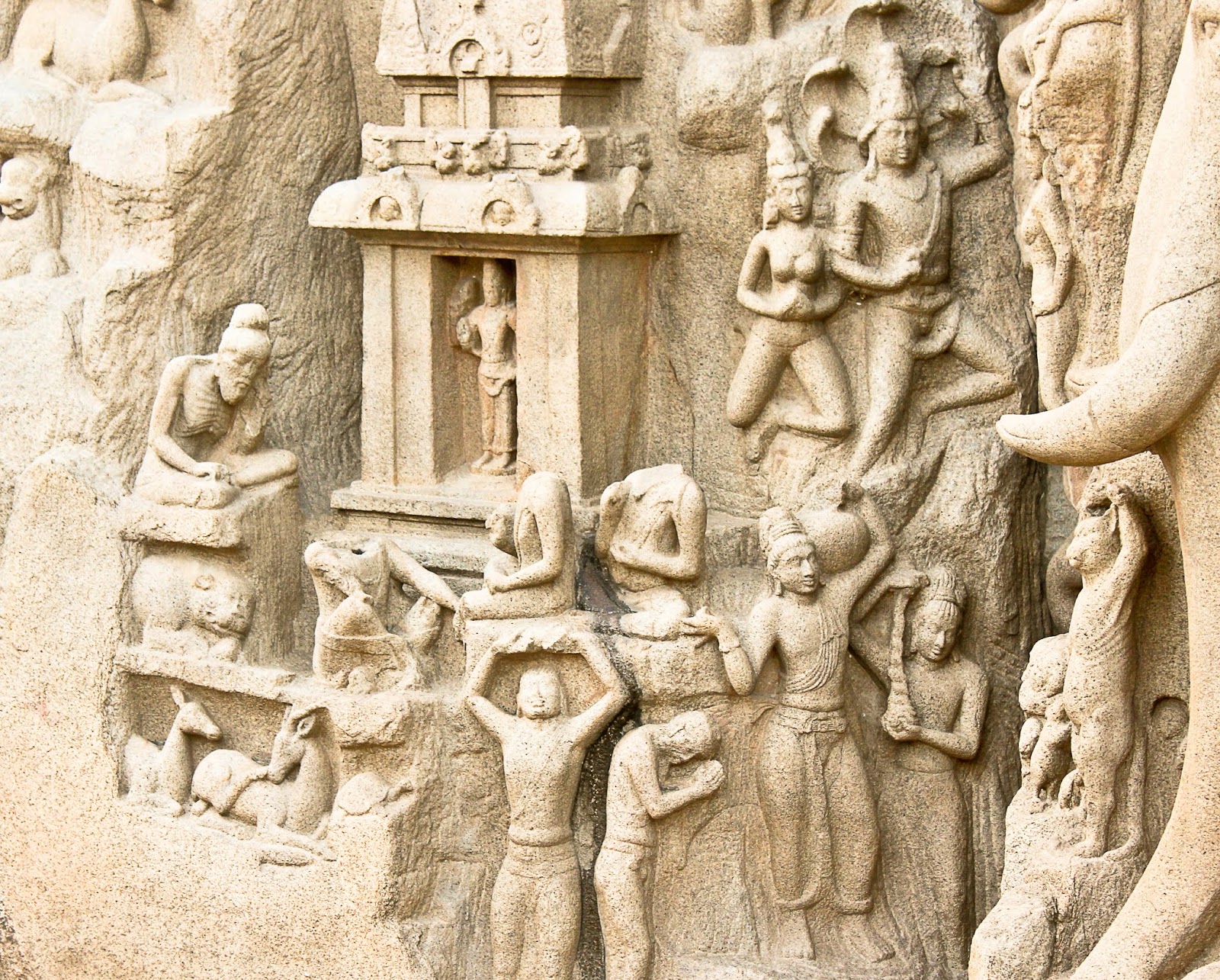
In the vicinity is a temple of Vishnu where a number of sages are depicted in yoga attitude in deep meditation, some with their legs fixed in paryanka-granthi or yoga-patta to ensure proper yogic posture. Below them are the disciples, one of them carrying water in a pot on his shoulder, another wringing out water from a wet cloth, a third engaged in suryopasthana
The vicinity of the hermitages of the sages is suggested by the presence of the deer fearlessly resting at ease near a lion. The radiation of peace and calm by the sages is reflected in a meditating cat, around which a number of rats are frolicking about. The portrayal of Nagas, usually associated with water, in the cleft, the temple, the sages, the suggestion of their dwellings and the disciples performing rituals possible only near water all these devices have been adopted by the sculptor to indicate that the cleft is intended to represent a river descending from the hills
This scene is generally taken to represent a story from Mahabharata in which Arjuna, the epic hero, performed penance to please Siva and to obtain a Pasupata weapon from him. This story was very popular about the time when the sculpture was executed. Bharavi a Sanskrit poet of the sixth century, adopted it for the theme of his Kiratarjuniya. This is also the theme that is carved on a pillar at Vijayawada containing an Eastern Chalukyan inscription of the tenth century and on the gopuram of the Brihadisvara temple at Thanjavur. In the Mahabalipuram sculpture, however an important part of the story . the fight between Arjuna and Siva disguised as a hunter is absent and this has led some to doubt the identity of the sculpture. According to them, the representation here is that of Bhagiratha's penance and Siva granting him the desired boon by agreeing to release Ganga from his locks, the scene representing the descent of the river from the jungle-covered hills in the joyful presence of the gods.
Vintage Photos of Arjuna's Penance Courtesy British Library
Mahabalipuram is derived from "Mamallapuram", the city of Mamalla, a title of Narasimhavarman I, the great Pallava ruler of the seventh century, who was responsible for scooping out most of the rock-cut temples and carvings at the place. But probably the name Mallai or even Mamallai was known earlier and used by early Vaishnava saints.
Another ancient name of the place was Kadalmallai referred to by the Vaishnava saint Tirumangaialvar, probably a contemporary of Nandivarman, one of the successors of Narasimhavarman he gives a graphic description of the harbour with its anchored ships laden with treasure, huge elephants and the nine gems. As Mallai, the place is known to be the birthplace of Bhutattalvar who preceded Tirumangaialvar.
The earliest reference to Mamallapuram in the European literature is found in the 'Carta Catalana' a world map produced in Spain in 1375, wherein the site is marked as 'Setemelti' an error for the Sette Templi or seven Temples in Spanish . In fact, this place was popular among the westerners particularly the mariners as the place of 'Seven Pagodas' possibly denoting the various superstructures of the temples that could be seen from the sea. Though the actual numbers exceed seven,
The Monuments at Mahabalipuram owe their origin to the Pallava rulers of south India . The Period between the later half of the sixth and the first half of the tenth century, nearly four hundred years is an important epoch in the history of south India and its culture. It coincides with the rise to power of three important dynasties, The Chalukyas of Vatapi modern Badami in Karnataka, The Pallavas of Kanchi modern Kanchipuram and the Pandyas of Madurai . The founders of the new Pallava dynasty of Kanchi were Simhavarma and his son Simhavishnuvarma alias Avanisimha. From the beginning, the Pallavas were a sea-faring people who spread Hindu culture in the Indian archipelago . The early inscriptions found here are written in the Pallava Grantha script.
Some famous tourist spots include the UNESCO world heritage site Group of Monuments like the Shore Temple and the Five Rathas
What is the best time to visit Mahabalipuram?
The best time to plan a trip to Mahabalipuram is when the winter season sets in, which is between October and March. The climate remains good with warm days and cold nights, ideal for outdoor activities and for exploring the town. The period from November to February is the peak tourism season when the climate is salubrious. Travelling to Mahabalipuram during summers are generally avoided because of the very high temperatures and the exhausting heat, which makes it difficult to travel around the town for sightseeing. The nearest airport is at Chennai
Rock hewn Kedareshwar cave of Fort Harishchandragad, Maharashtra, India. Temple dedicated to Lord Shiva. Local legend holds that when the fourth pillar breaks, the world will come to an end.
The cave of Kedareshwar, in which there is a big Shivlinga, which is totally surrounded by water. The total height from its base is five feet, and the water is waist-deep. It is quite difficult to reach the Shivlinga, as the water is ice-cold. There are sculptures carved out here. In monsoon it is not possible to reach this cave, as a huge stream flows across the way.
Indra with Airavata, Banteay Srei Temple, Cambodia
Dated: 10th century CE
The temple was dedicated to Shiva and known as Tribhuvanmaheshwar (त्रिभुवनमाहेश्वर मंदिर) in ancient era. Arch is also noteworthy which designed to represent sacred lotus petal. The same arch was used in almost all ancient Hindu palace with slightly different variations. However, out Colonial historians credit such arch(s) to fanatic Islamic invaders who didn't built any single building in their own homeland that could match in splendour to any of the thousands of monuments dispersed over India
Devi Chakreshwari from Jain temple complex, Dilwara(Rajasthan)
Dated: 11-12th century CE
She is shown sitting calmly on a throne flanked by attendant holding fly whisk. Devi is shown holding noose ,Chakra, arrow, snake, Vajra and Ankusha(elephant goad). Note the upper left panel of musicians carved in high relief.
The Kirtinarayana temple built in AD 1117 over a jagati has on plan a stellate garbhagriha, an open ardhamandapa and a navaranga with thre entrances. The gardhagriha doorways are finely carved in the hoysala style . The main image of Narayana is impressive and stands on a lotus pedestal in samabhanga .The navaranga is spacious has lathe-turned pillars and a ceiling adorned by creeper scrolls, lotuses and other floral designs.
The Vaidyesvara temple complex with mixed Ganga, Chola and Hoysala stylistic features is datable between circa 10th- 14th century AD. The temple on plan has a garbhagriha, an antarala, an ardhamanadapa, a pillared mahamandapa with an entrance porch or mukhamandapa in east-west orientation. The temple indented on plan also has a mukhamandapa to the south. The mahamandapa in the north has additional shrines for processional deities. The temple is built over a jagati. Its wall is treated with massive pilaster motifs with various deities of the Saiva faith. Over the garbhagriha is a brick and-lime vesara sikhara. The navaranga has six central pillars. The doorway of the navaranga shows Hoysala workmanship and on either side are dvarapalas about 2 m high. The temple has a spacious inner prakara with small shrines housing sculptures of the Ganga, Hoysala and Vijayanagara periods. The Vaidyesvara linga is held in high reverence. The tall gateway facing the main entrance has beautiful decorations.
It is believed that Nalanda University was established in the fifth century by Shakraditya ( Kumar Gupta I) of the Gupta dynasty who was the ruler of Magadha .It has been mentioned in history that Lord Mahavira and Lord Buddha stayed here. Evidence has been found that there were several temples at this place during the reign of Emperor Ashoka but Nalanda University came into existence during the Gupta dynasty .
According to known history, it is considered the worlds first residential university, where more than 10,000 teachers and students lived together. Learners and researchers from Japan, Korea , China , Tibet , Indonesia , Turkey , Greece and Persia used to come here .Religion , spirituality , history ,law,architecture, chemistry ,astronomy , Ayurveda , metallurgy and sculpture are a few of the subjects which were taught here. Chinese traveller Hsuan-tsang, who came to India in the seventh century, stayed here for 15 years.
The Veeranarayana temple of Belavadi is a daring trikuta temple with an uncommon plan situated 10 KM from Halebidu . After the famous temples of Belur Halebidu and Somanathapur this Hoysala temple is the most impressive one for a tourist visit . The temple has been built around 1200 AD and is carefully maintained by the Archaeological Survey of India .
In Bengal art sometimes was expressed mainly through the medium of temples. Brick temples of Bengal were built between the sixteenth and nineteenth centuries. These temples form one of the most distinctive groups of sacred monuments in India. Due to the multiple artistic influences acting upon the region, Bengali temples show a wide range of forms and techniques. “The Bengali temples nevertheless constitute a coherent series in both their architecture and sculpture, characteristically expressed in brick and terracotta. The geographical distribution of the temples is majorly confined to the alluvial delta of Ganges River, which explains the popularity of clay as material for all conceivable purposes. “Hence, Bengali temples can be viewed as important manifestation of this region’s culture, closely associated with contemporary movements in religion, literature, arts as well as political, social and economic development
Photograph of the Vishnu Temple at Govindapuram in the Kozhikode district of Kerala, taken by a photographer of the Archaeological Survey of India on the 1st February 1902.
Photograph of the Bhagavati Temple at Tiruvalathur in the Palakkad (Palghat) district of Kerala, taken by a photographer of the Archaeological Survey of India on the 1st February 1901
Doddagaddavalli is about 16 KM from Hassan on the Hassan - Belur highway,The temple build in 1114 C E commissioned by a merchant called Kullahana Rahuta and his wife Sahaja Devi,a gold merchant from Kolhapur ,The Lakshmi Devi temple found here is a small and modest monument, placed in the centre of a walled courtyard, This temple is unique because its a mix of Hoysala, Kadamba and Chalukya artitecture , The temple is a chaturkuta model , and this is the only chaturkuta Hoysala temple I have seen ,
Though the sculptural wealth of the Hoysalas is very well known through the magnificent examples of architecture and sculpture all over their realm, no example of the painter's art has been discovered so far. though no murals have been noticed in any of the temples, fortunately there are specimens of painting of the Hoysala period from their territory preserver for us in Moodbidri. These are painted palm leaf manuscripts at the Jain pontifical seat at Moodbidri and are objects of worship
These manuscripts, fortunately have been well taken care of in the ancient library at Moodbidri. By their paleography , clearly of the Hoysala period, and closely resembling the lithic as well as the copper-plate inscriptions of Vishnuvardana's time, they have survived , with their paintings of quality in bright colour, to give an idea of the art of Hoysala painter. it is interesting to compare the writing in these manuscript , with the letters composing the flowery lines in the metal plates from Belur temple. These paintings must be attributed to the time of Vishnuvardhana and his wife Santala , who was so devoted to Jainism
Its was very nice trip to Koravangala from Hassan , Koravangala is 10 Km from Hassan, The Bucheshwara temple found here is a well preserved monument under archaeological survey of India. The Temple has been build in 1173 AD by Buchiraja , an officer of Hoysala king Narasimha I, The temple is a 'dvikuta ' with two shrines facing each other .These shrines are connected by a succession of a closed hall and an open hall , There is a separate shrine for Bhairava . The western shrine facing east containing an image of Surya the sun god , and the eastern shrine contain a Shiva Linga, Near to the temple you can see the ruins of Sri , Govindeshwara temple .